
Introduction
Most mutual fund performance analysis starts with a simple assumption: good past returns mean a good fund. This assumption is wrong.
“I bought a fund because it was the top performer last year. Now it’s struggling. What did I do wrong?“
This question comes up in every investor’s journey. Maybe you have asked it yourself.
You see an ad. A fund house shows 40% returns in the last year. You think, “Why would I invest in anything else?” You invest. Then the fund underperforms.
The same fund that looked unstoppable is now somewhere in the middle. Or worse, at the bottom.
This is not bad luck. This is not a mistake you made.
This is how mutual fund performance actually works.
Let us explain why.
Why Past Returns Look So Attractive
Look at any fund advertisement. What do you see?
“Top Performer in its category.”
“Highest returns in 2026.”
“Consistent wealth creator.”
“If you have invested 30000 SIP it would be 1crore “
Past returns are everywhere. There is a reason for this.
Fund houses know what works. A big number grabs attention.
A 40% return feels real. It feels like proof.
And honestly, what other data do you normally see?
Risk metrics?
Benchmark comparisons?
Rolling returns?
No. You see just average returns.
Because returns sell.
As an investor, this feels logical. “This fund did well before. So it will do well again.”
That logic makes sense in most of life. A restaurant with great food yesterday will likely have great food today. A phone with a good battery last year will still have a good battery this year.
But mutual funds do not work this way.
What feels logical is not actually true.
What Actually Happens
Let us look at what happens to top-performing funds over time.
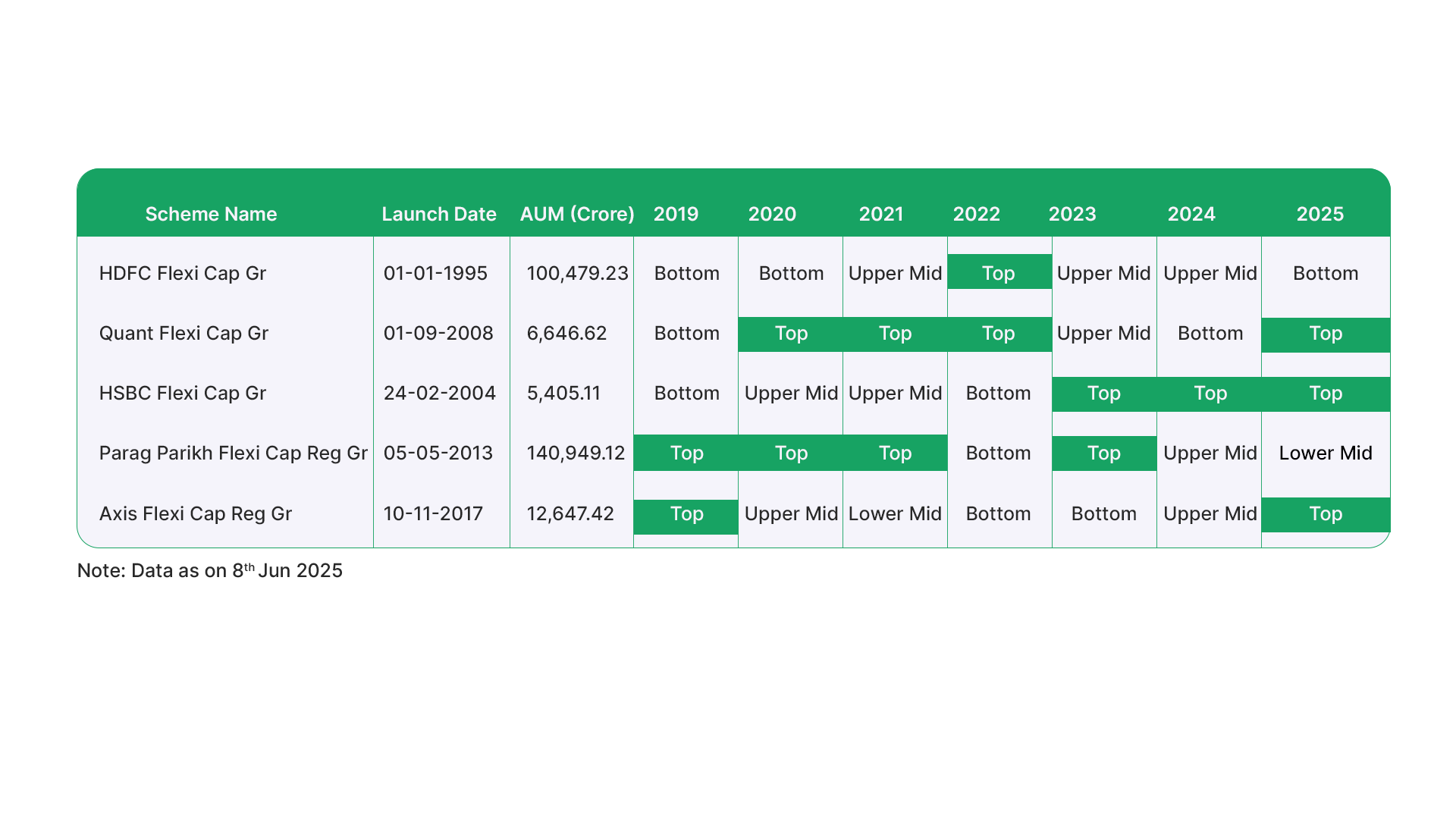
Here is the data from Flexi Cap funds between 2019 and 2025. The table shows each fund’s relative performance ranking each year
Flexi Cap Fund Quartile Rankings (2019–2025)
What do you notice?
No fund stayed on top every year. Not one.
Quant was Top for three years (2020-2022). Then Bottom in 2024. Then Top again in 2025.
Parag Parikh was Top for three years (2019-2021). Then Bottom in 2022.
HDFC went from Bottom (2019-2020) to Top (2022) back to Bottom (2025).
Top funds became bottom funds. Bottom funds became top funds. Every single year, the rankings change.
Now ask yourself: If you chased last year’s top performer every year, where would you be?
You would constantly buy funds after their best years. Then watch them struggle. Then switch to the next top performer. Then repeat.
That is not a strategy. That is a cycle of disappointment.
If the data is this clear, one question remains. Why do investors keep falling for this year after year? The answer is not about data. It is about how our brains are wired.
Why We Keep Falling For This (Recency Bias)
Here is the honest truth. Even after seeing the data, you might still feel attracted to last year’s top performer.
That feeling is not a weakness. It is biology.
Your brain is wired to give more weight to recent events. Psychologists call this recency bias. It happens automatically. You do not choose it.
Think about it. When a fund delivers 40% returns last year, that number is fresh in your mind. It feels real. It feels repeatable.
When another fund delivered 12% returns last year, it feels boring. Even if it has been consistently delivering 12-14% for ten years.
Your brain says: “40% is better than 12%. Why would I not choose 40%?”
But investing does not work like that.
Simple example: A batsman scores 100 runs in three matches in a row. You think he is unstoppable. In the fourth match, he gets out for zero. The recent past did not predict the future.
The same happens with funds. A great year does not guarantee another great year. A bad year does not mean the fund is finished.
The mistake is assuming recent performance is a promise. It is not. It is just what happened recently.
Recognizing this bias is the first step to overcoming it.
So if past returns are unreliable and chasing them is a bias, what should you actually look at?
What To Look At Instead
Stop asking: “Which fund had the highest return last year?”
That question has led you to disappointment. It will lead you there again.
Start asking better questions.
- Is the fund consistent across multiple years?
Not whether it was #1. Whether it stayed above its benchmark year after year. A fund that beats its benchmark by 2-3% every year is often better than a fund that beats it by 20% one year and falls behind the next two.
- Does it beat its benchmark regularly?
The benchmark is the real test. Beating the index by a wide margin one year means nothing if the fund cannot do it repeatedly.
- How much risk did it take for those returns?
A fund that delivered 15% returns with low risk is better than a fund that delivered 18% returns with very high risk. You cannot see risk in return numbers alone.
Past returns are not useless. They just cannot be the only thing. Use them to understand behaviour across different market conditions. Do not use them to predict next year’s winner.
The goal is not to find last year’s champion. The goal is to find a fund that can perform reliably over your investment horizon.
Here is a simple checklist to help you apply this framework before every fund selection.
Quick Checklist
Before you select a fund, run through this checklist.
Ask yourself:
- Am I picking this fund because it was the #1 performer last year?
If yes, stop. That is not a reason. - Have I checked performance across 3 to 5 years, not just 1 year?
One year tells you nothing. Multiple years show a pattern. - Does the fund beat its benchmark consistently?
Not once. Not in a good year. Year after year. - Do I understand how much risk the fund takes?
High returns with high risk are not a winning strategy.
Keep this checklist handy. Use it every time. It will save you from chasing last year’s winners and ending up disappointed.
Let us wrap this up with one simple idea.
Conclusion
Let us go back to the question we started with.
“I bought a fund because it was the top performer last year. Now it’s struggling. What did I do wrong?”
You did not do anything wrong. You were doing what almost every investor does. You trusted past returns. You trusted what fund houses advertise. You trusted what feels logical.
But mutual funds do not work that way.
Performance rankings change every year. Top funds become bottom funds. Bottom funds become top funds. Your brain is wired to chase recent winners. That is not a character flaw. It is human nature.
The fix is not to stop using data. The fix is to use the right data.
Stop asking which fund had the highest return last year. Start asking which fund is consistent, which beats its benchmark regularly, and which takes risk you are comfortable with.
The best investment decision is not the one that worked yesterday. It is the one that works for your goals over the next ten years.
Stop chasing last year’s winner. Start building a portfolio that lasts.
At iNVESTT, we help investors move beyond return-chasing. Book a consultation call for personalised fund selection guidance.
Disclaimer:
This article is for educational and informational purposes only and should not be construed as investment advice, investment recommendation, or solicitation to buy, sell, or hold any securities.
The views and opinions expressed are based on information believed to be reliable as on the date of publication. However, no representation or warranty is made regarding the accuracy, completeness, or adequacy of the information.
Investments in securities are subject to market risks. Readers should conduct their own research and consult their financial adviser before making any investment decisions.
SEBI Registration No.: INH000010858
Analyst Name: Gopi krishna Matcha
Pingback: Why Top Performing Mutual Funds Change Every Year