
Introduction
You have narrowed down your fund search. Two options. One Large Cap. One Flexi Cap. Both look good. Now you are stuck. flexi cap vs large cap – which one should you choose?
Every investor faces this question. Both categories invest in large companies. Both have delivered good returns. But they are not the same.
You look at a Large Cap fund. Stable. Predictable.
You look at a Flexi Cap fund. Flexible. Potentially higher returns.
You feel stuck.
That is normal. The difference between these categories is not obvious. Both seem similar. Both sound good. But they behave very differently in different market conditions.
Understanding that difference is the key to making the right choice.
Let us break it down. Simple. Clear. No confusion.
What is Large Cap? What is Flexi Cap?
Before you decide, understand what each category actually means.
Large Cap Funds invest in India’s top 100 companies by market capitalization. Think of companies like Reliance, HDFC Bank, TCS. These are established businesses. They are less volatile. They offer stability.
Flexi Cap Funds can invest across large, mid, and small cap stocks. They have the freedom to move between market caps based on where the fund manager sees opportunity. This flexibility can lead to higher returns. It can also lead to higher volatility.
So the real difference is this: Large Cap offers discipline. Flexi Cap offers flexibility.
But flexibility is not always good. And discipline is not always boring. It depends on market conditions.
Let us see how each category actually behaves when markets move.
How Do They Behave in Different Markets?
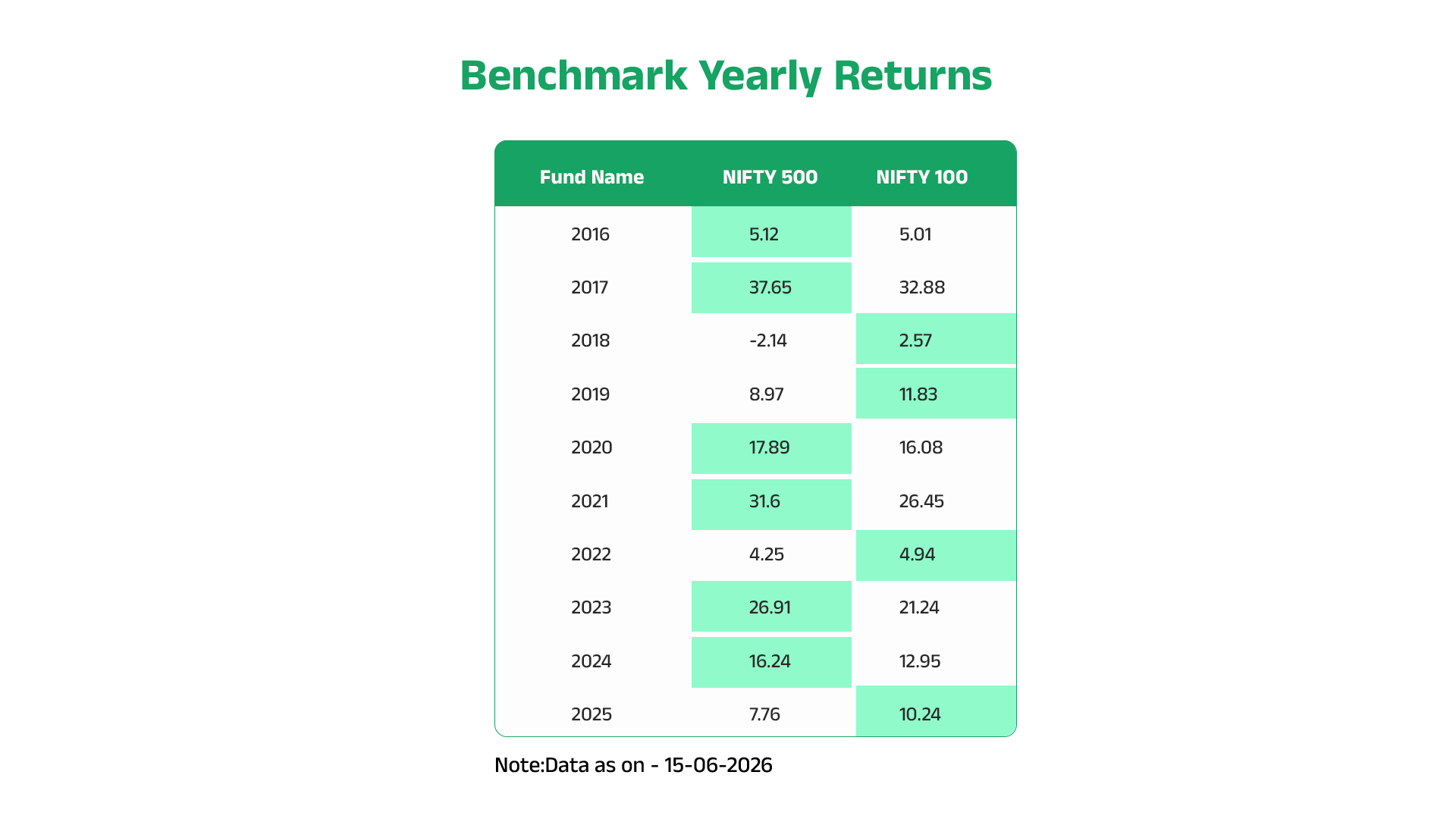
Here is the data. NIFTY 100 represents Large Cap.
NIFTY 500 represents the broader universe that Flexi Cap funds can invest in.
What do you notice?
NIFTY 500 outperformed in 6 out of 10 years. Especially in strong bull markets like 2017, 2021, 2023, and 2024.
NIFTY 100 outperformed in 4 out of 10 years. Especially in volatile or corrective years like 2018, 2022, and 2025.
So the pattern is clear. When markets are rising strongly, Flexi Cap (NIFTY 500) tends to do better. When markets are uncertain or falling, Large Cap (NIFTY 100) offers better protection.
Now the question is: which one fits you?
Which One Should You Choose?
Here is a simple framework. Ask yourself two questions.
Question 1: What is your time horizon?
If you need the money in less than 5 years, Large Cap is the safer choice. It offers stability and lower volatility.
If you have 5 to 10 years, Flexi Cap makes more sense. The flexibility to move across market caps can help capture growth across different market phases.
If you have 10+ years, both can work. The choice then depends on your risk comfort. How to Compare Two Mutual Funds Properly.
Question 2: How do you react when markets fall?
If you check your portfolio daily and panic during corrections, Large Cap is for you. The ride is smoother.
If you stay calm during volatility and do not lose sleep over short-term falls, Flexi Cap could be a better fit. It can deliver higher returns over the long run.
Your time horizon and risk behavior decide the answer. Not the fund with the highest recent return. Having a proper Mutual fund comparison framework helps when choosing between funds.
flexi cap vs large cap – Which Fits Your Portfolio?
Now that you understand the difference, let us talk about your portfolio.
Large Cap and Flexi Cap are not competitors. They can both have a place in a well-diversified portfolio.
A Large Cap fund acts like the anchor. It provides stability, especially during market corrections. It may not give you the highest returns, but it helps you stay invested when markets get volatile.
A Flexi Cap fund acts like the growth engine. It gives your portfolio exposure to opportunities beyond large caps. In strong bull markets, it can deliver higher returns. But it can also fall more when markets correct.
So here is a simple rule of thumb.
If you are a conservative investor or have a shorter time horizon, a Large Cap fund should form the core of your equity allocation.
If you are a moderate-to-aggressive investor with a longer time horizon, a Flexi Cap fund can give your portfolio an edge.
And if you are unsure, you can always hold both. Many investors do. A Large Cap fund for stability. A Flexi Cap fund for growth.
The key is to understand what each category offers and choose based on your goals. Not based on which category performed better last year.
Conclusion
Large Cap and Flexi Cap are not competing products. They serve different purposes in your portfolio. Large Cap offers stability when markets turn volatile. Flexi Cap gives you the potential to capture growth across market caps.
The choice is not about which one is “better.” It is about which one fits your goals, your time horizon, and your comfort with risk.
Most investors pick a category based on recent returns. That is a mistake. The right choice comes from understanding how each behaves in different market conditions—and matching that to your own situation.
Now you know the difference. You know how each performs in bull and bear markets. You have a framework to decide.
If you are still unsure which category belongs in your portfolio, do not guess. We review portfolios every day and help investors make these decisions with clarity. Book a call with us. We will look at your goals, your existing funds, and your risk comfort, and tell you what fits.
Disclaimer:
This article is for educational and informational purposes only and should not be construed as investment advice, investment recommendation, or solicitation to buy, sell, or hold any securities.
The views and opinions expressed are based on information believed to be reliable as on the date of publication. However, no representation or warranty is made regarding the accuracy, completeness, or adequacy of the information.
Investments in securities are subject to market risks. Readers should conduct their own research and consult their financial adviser before making any investment decisions.
SEBI Registration No.: INH000010858
Analyst Name: Gopi krishna Matcha